Side By Side Review: Stone Smoked Porter Variations

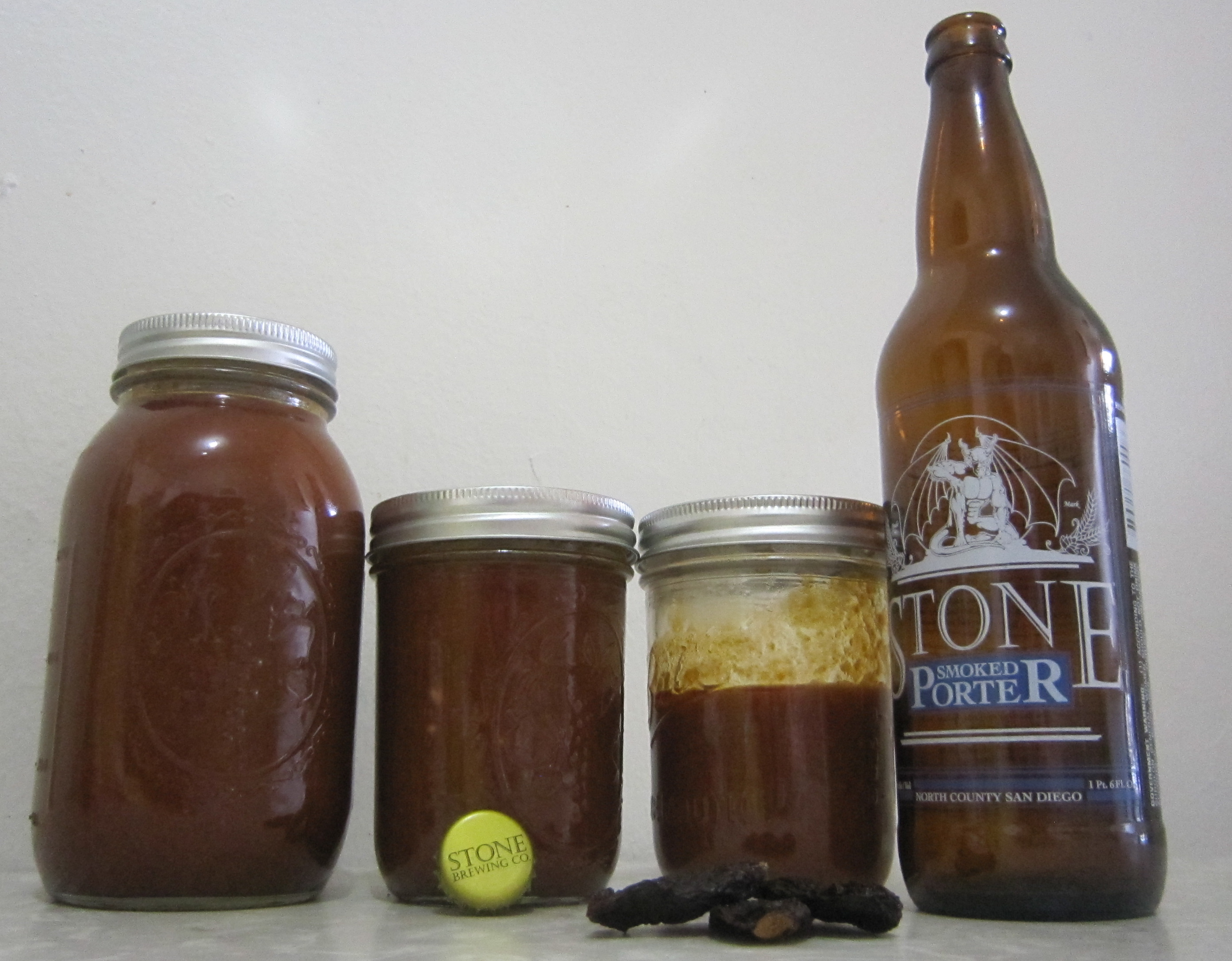
As one who tries to attend as many special Stone Brewing Co. events at my local New York City beer bars as possible; I was excited to hear that two variations on their Smoked Porter that I previously tried and enjoyed both on tap and cask were being released in bottles. After splitting a bottle of the Vanilla Bean version with a friend at The Ginger Man bar in NYC I quickly sought out a bottle of each version (SP w/ Chipotle Peppers and SP w/ Vanilla Bean) to include in a tasting that I planned to have with my older brother a few nights later. In order to make the most out of the experience of drinking these two special brews my brother and I split them evenly. I drank from two identical Duclaw Brewing Co. snifters and my brother drank from two Flying Dog Brewery taster glasses. After analyzing each beer we decided to blend them to taste how the flavors would play off each other.

click picture for more info. on this beer

Having had the Vanilla Bean more recently I chose to start this side by side tasting with the Chipotle Peppers version. As per its style it poured dark brown in color with half a finger of khaki head that quickly dissipated and left behind a bit of lacing and alcohol legs. Moving on to the aroma, I was curious to see how the smokiness of the chipotle peppers would blend with the smokiness from the smoked malts. At first it seemed like the two blended together and were hard to separate. However, the more I smelled the beer, the more I felt that the chipotle added a perceived dryness to the aroma and tamed the meaty quality of the base beer’s smokiness (from its smoked malts). In addition to the smokey aspects of the aroma I picked up a bit of milk chocolate and roasted malt. As in the aroma the smokiness was the first flavor that hit my palate in the taste. First it came from the chipotles then the smoked malts (meaty quality). In the finish hints of milk chocolate and coffee were joined by a touch of pepper heat and earthiness. At 5.9% ABV, this beer’s mouthfeel was on the lower end of medium bodied, which at times lent itself to a somewhat watery finish. Overall, I thought this version was well executed, but didn’t really excite my palate as much I thought it would. Rating: 6.5/10

After taking a few sips of the Chipotle Peppers version and writing down my initial tasting notes, I put my glass to the side and picked up the Vanilla Bean version. While the appearance was pretty much the same as in the Chipotle version, this beer’s head stuff around a bit longer which helped intensify the flavors and mouthfeel in my initial sips. In my opinion the vanilla beans made this beer into a great dessert beer. This came about by the big espresso and milk chocolate notes that blended with the vanilla in both the aroma and taste. Furthermore, by bringing out the rich chocolate notes, the beer seems quite sweeter than both the base Smoked Porter and the Chipotle Pepper version. While some of my friends that I’ve spoken to about this beer have mentioned being able to tasting the smokiness of the smoked malts in this version. I personally did not taste any smokiness until the beer warmed up and even then it was quite faint and only detected in the finish. Next, in terms of mouthfeel this version was also on the lighter side of medium bodied, but differed in that the vanilla gave me the impression of a creamier mouthfeel. Lastly,  due to the sweet milk chocolate flavors and muted smokiness and darker malt character of this version, I would probably need to be in the mood for this version’s flavor profile in order to order it at a bar or buy it at a beer store. Rating: 7.5/10

As mentioned above the next and last step in the side by side tasting was to make a 50/50 blend of the two variation on Stone Smoked Porter. In order to blend the two beers I poured the Smoke Porter w/ Vanilla Bean into the Smoked Porter w/ Chipotle Peppers’ glass and swirled the beer around. In doing so I was able to regenerate a finger khaki head, which stuck around as I drank the blend. As I analyzed the aromas and flavors there was a battle being fought on my palate between the smoky and spicy chipotles peppers and the sweet vanilla beans. In the end the Chipotles won with their heat that intensified with each sip of this blend. In the future a better blend would be  3 parts Vanilla Bean to 1 part Chipotles Peppers. Rating: 7/10

Adventures Into The Mind of a Beer Geek: As mentioned in previous reviews variations on or additions to a base beer leave room for the base beer or style’s identity to be minimized for even lost. However, with such as a coveted beer as Stone Smoked Porter; opinions on the success of the above variations will have a wide range. In the end I applaud Greg Koch, Mitch Steele, and the Stone Brewing Company staff for bottling these variations in order to highlight specific characteristics of the base beer in an artisinal manner. However, in the end of the day I prefer this beer without anything added both as a porter and a smoked beer. I should note that while proofreading this post I thought of a possible way to help me further appreciate these variations (versions), which is to pair them with complementary foods. I’d recommend pairing the Smoked Porter w/ Chipotle Peppers w/ grilled or smoked meats, beef entrees (spicy or not), or aged gouda. For the Smoked Porter w/ Vanilla Bean I go for desserts like tiramisu, chocolate cake, and chocolate mousse, and desserts with white chocolate. Cheers!

Posted in Beer Reviews | Tagged , , , , , , , , , | Leave a comment

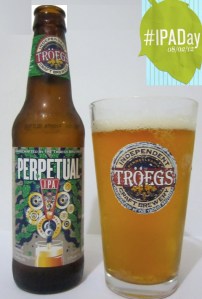
International IPA Day 2012: Troegs Perpetual IPA

BREWERY’S DESCRIPTION: In our constant evolution as a brewery, we’ve developed an undying drive to meld the organic and the mechanical. Perpetual IPA utilizes our hopback and dry-hopping to engineer a bold Imperial Pale Ale. Perpetual IPA is 7.5% ABV and 85 IBUs. It features Bravo, Chinook and Mt. Hood hops in the boil, Mt. Hood and Nugget hops in the hopback and Citra, Cascade and Nugget hops in dry-hopping.

“Straw in color and bittered with an abundance of citrus and spicy hops, Perpetual IPA is a tribute to building our new brewery and our desire to continue exploring,” says John Trogner.

On Thursday, August 2, 2012 craft beer drinkers all the over the world and especially in the US celebrated one of the most popular beer styles nowadays i.e. the India Pale Ale (IPA). As a self proclaimed “hop-head”, I was well prepared for this special day with a fresh (bottled 7/25/12) six pack of Troegs Brewing Company’s Perpetual IPA that I purchased one day prior at Whole Foods Bowery Beer Room in New York City.

Having not tried this beer since November 2011 I was excited to get it into my Troegs pint glass and get to analyzing its hop character. It poured slightly hazy straw in color with orange highlights and a 1.5 finger head. One interesting (somewhat significant) feature of this beer’s appearance was that on the label it says that the beer is “gently filtered to maintain some live yeast and fresh hop essence in every bottle”. From my observation the haziness that was there cleared up as I drank the beer, which would indicate minimal leftover yeast. However, this factor did not significantly diminish the great appearance of Perpetual IPA. Its resinous hops left behind plenty of sticky lacing behind as its head diminished.

From the aroma to the taste this beer was “West Coast” in its hop character and flavor profile. Meaning, upfront were big notes of grapefruit rind, sweet orange, and some tropical fruit. All of which were followed by dry biscuity malt character. Though one could think those flavors would lead to a resinous and quite bitter finish; as the beer washed over my palate its malt character intensified and blended with the hops which left a moderate dryness and nice spiciness on my palate. By intensified I mean that it ranged from being dry and biscuity to slightly caramel-like in nature, which helped it accent both the citrusy and spicy flavors from the hops.

In terms of overall mouthfeel and level of bitterness, Perpetual IPA had a smooth medium body with just the right amount of carbonation to heighten its bitterness as it hit my palate. As mentioned above, the bitterness did not leave a sticky or resinous bitterness on my palate, which definitely aided this beer’s drinkability. One final factor that excited me about this beer was its freshness. Meaning, when I first tried it back November 2011 its hop character had faded significantly and I was not able to enjoy or accurately assess its hop flavors and aromas. Now that I’ve tried it again, enjoyed it, and heard that it was added to Troegs Brewing Co.’s  year round line up. I will definitely be buying it on a regular basis. Rating: 8/10

Adventures Into The Mind of a Beer Geek: The popularity of hop forward (hoppy) beers nowadays brings to mind an interesting trend amongst those who have dedicated themselves to developing their beer palate by drinking craft beer. What I mean by this is that many popular beer styles nowadays represent extremes in flavor characteristics. As such, many craft beer drinkers quickly become “hop-heads” after acclimating their palates to hop bitterness. Falling on the other end of the flavor spectrum are the American and Russian Imperial Stouts, and in some cases other malt forward beer styles such as the porter (and its sub-styles). In this case those who have yet to drool over pungent hop flavor and bitterness can enjoy big dark chocolate and coffee flavors and those who seek another extreme in flavor can experience the potential of a strong malt character. However, I’d be remised if I didn’t mention a third extreme in flavor that has emerged over the past few years in the craft beer community. This third extreme includes various beer styles brought together in the genre known as “sour beers”. Fermented with wild yeast strains at times inoculated with souring bacteria; these beers hit the palate with funky and tart flavors that at first cause one to pucker. But as with hop forward beers, they eventually cause one’s mouth to water. In the case of my personal palate development I can definitely identify with this “extremes of the beer flavor spectrum” trend and have been trying hard to not allow other flavorful and important beer styles get lost in the midst of my seeking out the next great hoppy IPA, barrel aged Imperial Stout, or rare sour. In turn, my hope for both new and experienced craft beer drinkers is that beer styles in between these three extremes of flavor should never have their importance for palate development diminished. Cheers!

Posted in Beer Reviews, Craft Beer Advocacy | Tagged , , , , , , , , , , | Leave a comment

Brooklyn Brewery Brewmaster’s Reserve Fiat Lux Preview and Release Party

Note: At certain points in this video you may have to raise your computer’s volume. Both of Garrett’s speeches at this event were filmed in environments that were not ideal for filming situations where audio quality is an important factor (e.g. outdoors and in a crowded room)

click here to see my photos from this event

On Monday July 30, 2012 beer bloggers, beer writers, and friends of Brooklyn Brewery gathered to celebrate the release of the newest addition to their Brewmaster’s Reserve Series called Fiat Lux. Prior to the release party at the brewery Brooklyn brewers, staff and a bunch of those invited to take part in the festivities took in the evening air at a smaller event (“Preview”) at the Wythe Hotel; directly across the street from the brewery. While getting early tastes of Fiat Lux brewmaster Garrett Oliver gave an in depth talk about the inspiration behind his latest beer. Afterwards the release party quickly got into full swing and as you’ll see in the above video, Garrett introduced a special video made for the event.

Being that I knew I would mostly likely try more than one Brooklyn Brewery beer during the evening’s festivities, The Preview allowed me to do the following. Firstly, I was able to take my time getting to know the complex flavors of Fiat Lux. Next, along with a small crowd of fellow beer bloggers and writers I was able to learn a lot about what it means to be a good brewer and beer journalist nowadays. Lastly, through  his roof top remarks I was able to come to a greater level of appreciation for all the hard work that goes into conceptualizing and then brewing new beers at Brooklyn Brewery.

Tasting Notes (click here for a short clip showing all the beers discussed below and their stats):

Fiat Lux poured a beautiful straw to light golden color with a fluffy white head. Over time it condensed and left a nice amount of lacing along the sides of my glass. The wheat malt used  (American Madsen un-malted white winter wheatcontributed some haziness to the beer’s appearance, which enhanced both its attractiveness and stylistic authenticity. At serving temperature the aroma consisted primarily of a pungent herbal and spicy quality along with hints of coriander and sweet maltiness. In fact after my first couple of sips I remarked to a friend that the beer’s taste and aroma reminded me of both Brooklyn’s Sorachi Ace and Pretty Things Beer and Ale Project’s Jack D’or (both saison/farmhouse ales). However, as the beer warmed up the hops and lime peel broke through and took on the sweet orangey and grapefruity flavors commonly found in American india pale ales (IPAs). In his remarks about Fiat Lux Garrett mentioned that its bitterness comes from both generous additions of Cascade, Chinook, Columbus, Centennial, and Perle hops along with the tart bitterness of lime peal added in the brewing process. As such to me the bitterness was just right in that it was assertive upfront, but faded smoothly and left my palate clean, refreshed, and ready for my next sip. One final notable quality of this beer was (is) its mouthfeel. Clocking in 6.1% ABV Fiat Lux is a bit higher in alcohol content than most widely available Witbiers. The extra heft brought its body up from light to medium, which to me increases its versatility for food pairings and settings where it can be enjoyed. Rating: 8.5/10

 Released on July 20, 2012 The River, a barrel-aged Belgian Pale Ale represents the third installment into The Worshipful Company of Brewers series.  A series in which “each member of the Brooklyn Brewery brewing team will design and create a batch of his/her own draft-only beer, to be served exclusively at the brewery’s tasting room.” Prior to my arrival at the brewery all I knew about this beer was that it was a barrel-aged Belgian Pale Ale (7.5% ABV). As a beer geek that was definitely enough to peak my interest. Once it was in my glass I quickly looked at Brooklyn Brewery’s blog on my phone for some additional information.  From the malts to the hops to the choice of wine barrels (click picture for more info.), I realized that Dan Moss (its brewer) put a lot of effort into making sure that the finished product would have a layered complexity to it. The River’s color rested somewhere between amber and orange (“burnished gold”) and was topped with one finger of off white head. Its malt character reminded me of a biere de garde i.e. it had a balanced sweet and biscuity flavor to it and was accented by a hint of brown sugar. As the beer moved over my palate I picked up fruit and spice notes reminiscent of a Belgian tripel including sweet peach, pineapple, and some stone fruits. I should note that while putting together these notes I spoke to Dan Moss and he informed me that most of the fruit character in the beer came from the wine barrels that the base beer was aged in. The spice came in as the finish was rounded out by some oak, clove, and additional sweetness. With its unique blend of strong (complex) flavors, medium body, and great drinkability, The River surely lived up to its namesake. Rating: 8.5/10

Continuing on with beers I hadn’t tried before this event, I chose AMA Boinda next. “Brewed by Amarcord Brewery in the small medieval town of Apecchio, Italy, AMA Bionda is a beer made specifically for the Italian dinner table. Designed by Brooklyn Brewmaster Garrett Oliver, AMA Bionda is a golden beer…born of aromatic malts, three types of hops, Italian Orange Blossom honey from Sicily, and water from springs that date to Roman times.” True to its description its body was straw to light gold with some cloudiness. Its one finger white foam quickly dissipated and left minimal lacing. Akin to a Saison its aroma was herbal, spicy, and lemony. In my initial sips these qualities followed through into the taste and were joined by some sweet bready maltiness and hints of honey in the finish. However, as a collaboration beer I hoped the beer’s complexity would increase as it warmed up. So after chatting with some of my fellow bloggers for a few minutes I took a minute to dissect AMA Bionda’s flavor profile. As the herbal flavors died town a nice clove like spiciness lent balance and a pleasant orange flavor joined the bready malts in the finish. Lastly, though the initial flavors reminded me of a Saison, once the beer warms up a bit its flavors were similar to a spicy German hefeweizen (e.g. Weihenstephaner Hefeweissbier). Rating: 7/10

For my last new beer of the night I went with Radius, “a saison that harks back to the days when farmhouse beers were session beers, full of flavor, but light enough that you could stick with them all day or all evening. At only 4.8% ABV, Radius is among the lightest beers we’ve ever made…Our Belgian yeast strain gives complex spicy notes and some bright orange zest flavors, while Perle and Aurora hops give a zippy bitterness and a pleasant floral aroma. Radius is bone-dry, unfiltered, hoppy, and refreshing.” As the brewery’s description states Radius was pale straw in color with a two finger white head. It’s lemony, grassy, and bready qualities reminded me a bit of German lager, but its clove-like spiciness (in the finish) brought me back to focusing on its designation as a table Saison or “session beer”. Personally I did not pick up the complexity of flavor that I usually look for in beer brewed with a lower ABV yet complex flavor profile in mind. However, I could see myself ordering this at a bar as my first beer of the night for its refreshing drinkability. I should note that Radius is only available in the borough of Brooklyn. Rating: 6/10

As one of my go to Brooklyn beers I chose to split a glass of their Blast! double IPA with a friend before grabbing one last glass of Fiat Lux before ending my drinking for the night. Its complex hop profile is comprised of a blend of English and American hop varietals (Ahtanum, Simcoe, Willamette, Centennial, Palisade, East Kent Golding, Northdown, Challenger, and Fuggle) in order to represent Brooklyn being “half-way between the hop country of Yakima Valley, Washington and the hop country of Kent in England.” As a means of balancing all those hops (5 lbs. per barrel) “Maris Otter and German Pilsner malts bring solidity, balance and beautiful flavors to a golden beer that’s ludicrously hoppy, strangely quaffable and oddly compelling. You won’t even know what hit you.” From the tap it poured a vibrant orange hue with a close to three finger big, bubbly head. As with many well formulated double IPA, the head lasted quite long and left a considerable amount lacing on my glass. Having enjoyed this beer on many occasions I was in hophead heaven when it’s aroma was pretty much bursting out of my glass with notes of grapefruit, orange, peach, and pine. All of which were balanced and made seemingly more juicy by some lightly sweet malt character. The “juiciness” of the hops came full circle in the taste with a balance of bitter grapefruit and orange flavors from the generous hopping and hints of pine and bready malts in the finish. At 8% ABV was a bit lighter in body than some other double IPAs, which made gave the beer a refreshing quality (refreshing for a hop lover). Rating: 8/10

Cheers to the brewers and staff of Brooklyn Brewery for a great night!

Posted in Uncategorized | Leave a comment

Beer Review: St. Bernardus Pater 6

BREWERY’S DESCRIPTION: This name became a reference. This beer is mostly pointed out with its product name: “a Paterke”. This “Paterke” is a chestnut coloured dark beer with a high fermentation (6.7 alcohol content) and a full taste.

Over time many craft beer geeks have placed beers from St. Bernardus on their list of go to Belgian beers. As such, after having tried every one of their beers besides Pater 6, I was glad to find some bottles of it while at a NJ beer store about a week ago. Clocking in at 6.7% ABV, I was curious to see how this Belgian Dubbel would compare to its bigger brothers aka Prior 8 and Abt 12.

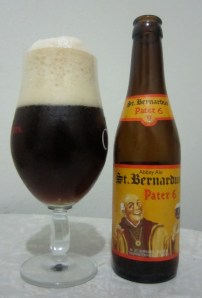
After deciding to use my Corsendonk glass for this beer, I poured in the entire contents of the bottle (including the yeast). In terms of color it poured an opaque ruby red with a fluffy three finger head (mix of large and small bubbles), and lighter red highlights when held up to light. Over time the head slowly condensed to 2 fingers in size and left great lacing.

When it comes to Belgian beers I look to the aroma as an indicator of how complex the taste will potentially be. However, in the case of Pater 6 the initial  aroma was a bit puzzling. I was met with a perfumey spiciness that was at times a bit soapy in nature. Though, behind that there was some nice Belgian candi sugar sweetness, alcohol esters, and a touch of lemon.

To my surprise the taste was initially much different in that my palate was met by a burst of dark fruits (cherry, dates), belgian candi sugar, and bubblegum. As the beer warmed up those flavors mixed with the perfumey / spicy yeast notes from the aroma and at times I picked up a slight woody quality at mid palate. As is with many Belgian beers, the finish was a bit dry and the dark fruits and yeast character lingered after each sip.

Pater 6’s mouthfeel was similar to others Belgian dubbels in that it had a medium mouthfeel and some tongue prickling carbonation in the finish. As I finished the beer I began to compare it to it’s bigger brothers and found it to be both similar and different. Meaning, while it did have some great characteristically belgian flavors, its yeast character and aroma were quite different than in the Prior 8 and Abt 12. In the end I would buy this beer again for its unique blend of flavors. However, when in the mood for a dubbel I’d probably go for Prior 8 or Westmalle Dubbel. Rating 7/10

Adventures Into The Mind of a Beer Geek: Over the past few months I’ve met a bunch of craft beer drinkers who say that they are not big fans of Belgian beers. While I can accept that every beer drinker has his or her own preferences. I feel that developing a knowledge and appreciation for Belgian beers is an important factor in developing one’s palate and realizing the extent of yeast’s influence on beer’s flavor profile. In addition, Belgian beers tend to have added ingredients such as dark and light candi sugar, orange peal, and coriander in them. So to me Belgian beers can be compared to a musical symphony where all its (their) parts need to meld together to produce a enjoyable final product. Yet another beer style that is worth mentioning here for its yeast strain’s influence is the Hefeweizen or German wheat beer. Its characteristic flavors are bubblegum, clove, banana, and lemon; most of which come the hefeweizen yeast strain. So in conclusion while you may not need Belgian beer styles in your list of go to styles, having an appreciation for what they bring to one’s palate development is in my opinion a must.

Posted in Beer Reviews | Leave a comment

Beer Review: Founders Frangelic Mountain Brown

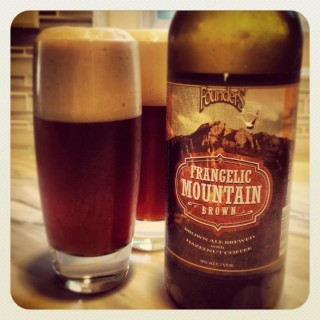
photo courtesy of untappd.com

BREWERY’S DESCRIPTION
“Frangelic Mountain Brown is the quintessential taproom “one-off” beer: Founders’ brewers created the Mountain Brown series for their taproom in Grand Rapids in 2007. Frangelic Mountain Brown is the 16th iteration in the series of popular brown ales—and it likely won’t be the last. The singular characteristic of this beer comes from the use of hazelnut coffees in the brewing process. The beer has distinct aromatics with sweet and nutty flavors beautifully balanced. Founders is known for its beers made with coffee (i.e., the Breakfast Stout series), but this is both the brewery’s first brown ale and its first beer brewed with hazelnut coffees to be bottled. It clocks in at 9% ABV.”

Having tried the three previous releases from Founders Brewing Company’s Backstage Series, I was excited to try their version of a beefed up brown ale with hazelnut coffee added. Upon purchasing Frangelic Mountain Brown the big question on my mind was…How prominent would the hazelnut coffee be in the beer’s aroma and flavor profile? In addition, brown ales tend to be commonly criticized for their lack of flavor or the “wow factor” that many beer geeks look for. While I tend to avoid such “style bashing”, I still made sure to go into this beer with the same open mind that I try to have when trying any beer that I am drinking for the first time.

After splitting the 750ml bottle with my older brother I took a second to admire the beer’s magnificent dark red color, which reminded me of some english brown ales that I’ve tried in the past. Though when held up to the light I could see some hints of brown. As the beer settled it was topped with a one finger off white head, which left an attractive amount of lacing and alcohol legs on my snifter glass.

After a quick mental drumroll I put my glass up to my nose and took my first whiff of Frangelic Mountain Brown. As expected I was met by strong notes of hazelnut coffee which were followed by hints of toffee and milk chocolate, and a touch of roasted malt. The dominance of the hazelnut coffee in the aroma ushered in a bit of apprehension prior to my first sip. In other words, I hoped the same wouldn’t be the case for the beer’s taste.

Indeed the coffee was again dominant in the beer’s flavor profile. This left other typical brown ale flavors such as toffee and roasted malt character as background hints, which needed to be thought about in order to be perceived. What eased the drinking experience for me was this beer’s smooth and creamy mouthfeel. At 9% ABV, the beer glided over my palate like a 6% brown ale would and helped prevent the hazelnut coffee flavor from becoming overwhelming to my palate.

If you’re a fan of Founders Brewing Co.’s beers, brown ales, and or beers with coffee added I’d recommend giving this beer a try. Though I should note here that despite its limited availability I chose to purchase and try this bottle before making the decision of whether to pick up second one. In turn, while I did purchase a second bottle of the previous three Backstage Series beers, I decided not to continue that trend with Frangelic Mountain Brown. Rating: 7/10 (BA 3.58 / 5)

Adventures Into The Mind of a Beer Geek: As was mentioned above I tend to shy away from style bashing or better put removing a beer style from the list of styles that I enjoy drinking. This is because I feel that for every beer style there is an example or number of examples that I or any beer geek can come to enjoy. In the case of brown ales I have found various examples that I have enjoyed and then revisited over time. However, the tricky part in today’s craft beer culture is the trend where brewers take a classic beer style and up its alcohol content for a special release (or even year round) beer. Doing so introduces the risk of losing track of the original beer style’s identity in the finished product; and or as in the case of  Frangelic Mountain Brown, an added component (e.g. hazelnut coffee) can mask other flavors which could potentially represent the existence of an admirable level of complexity.

Posted in Beer Reviews | Tagged , , , , , , , , , | Leave a comment

Garrett Oliver: Brewmaster of Brooklyn Brewery @ Buddha Beer Bar 7/19/12

Click Here for photos from this event

On Thursday 7/19/12 Buddha Beer Bar held a special event featuring 11 different beers from Brooklyn Brewery. As a special treat for all those in attendance, brewmaster Garrett Oliver was present to chat about his beers. Having met and gotten to know him in the past, it was great to catch up with him about things going on at Brooklyn Brewery and in the craft beer world. Of course I filmed our conversation and I hope you enjoy it as much as I did. I should note that beyond the information shared in the above video Garrett shared lots of additional future plans for his newly expanded. Therefore, I advise that you visit the brewery’s website on a regular basis to stay up to date with current projects, beer releases, and events.

Tasting Notes:

Blanche de Brooklyn (Witbier, 4.5% ABV): Having not heard of this now year round Brewmaster’s Reserve beer (tap only) before this event I was excited to try Brooklyn’s version of a Belgian witbier. It poured hazy straw in color with a thin white head with small bubbles. Upon taking a whiff I knew I’d like the taste because there was a good amount of spicy clove notes from the yeast i.e. I prefer spicier witbiers. In addition to the clove I picked up some lemon, wheat malt, bready notes. The taste followed the aroma quite well with a burst of lemon and clove notes leading to a sweet yet spicy finish. True to style this beer’s body was on the lighter side, but its balanced finish left me craving my next sip. If you like your witbiers on the spicier side like me, this is definitely a beer you should seek out. Rating: 8/10

The Companion (Wheatwine, 9% ABV): Released in September 2011 to celebrate Oxford University Press’s The Oxford Companion to Beer, “the most comprehensive book on beer ever published”, which Garrett Oliver was editor-in-chief of; this wheatwine was brewed with a variety of floor malted base and specialty malts and Domestic Willamette, German Perle, and Styrian Goldings hops. In the glass The Companion featured a beautiful light golden color with a thin off white head which left a fair amount of alcohol legs along my glass. At first the aroma which consisted of sweet caramel and toffee notes coupled with dark fruits such as plum and cherry. However, as I began to drink this beer I remembered that it had some age on it, which lent itself to the matured flavors that met my palate and at times reminded me of a scotch ale. In the finish I picked up a hint of the wheat malt, faint anise notes, and a touch of the remaining alcohol heat. Rating: 8/10

Black Chocolate Stout – 2008 vintage (Russian Imperial Stout, 10% ABV): As one of my go-to winter seasonals, this was the beer that I was most excited to try at this special event. True to style it poured with an opaque black body and was topped by a thick two finger khaki head. It’s aroma was quite different than more recent vintages in that it did not have as much fruity esters and amazed me with huge notes of dark chocolate, cocoa nibs, roasted malts, and espresso coffee. In the taste the espresso coffee and dark chocolate dominated and lingered into the beer’s long finish. As was expected, this beer was a sipper due to its full body which allowed me to savor it while I interviewed Garrett. Rating: 9/10

Monster Ale – 2011 vintage (English Barleywine, 10.8% ABV): As my final beer of the night I chose to get a 5oz pour of Brooklyn’s Fall seasonal barleywine. With a transparent amber color and a half finger off white head, its alcohol content lent itself to a fair amount of alcohol legs. In both the aroma and taste I picked up complex notes of nutty caramel and toffee along with some floral hops. What I liked most about this beer was its balance. Meaning, in the past I’ve tried older vintages (e.g. 2 year old bottles) and found them to be a bit sweet, but this vintage had just enough remaining hop character to lend balance and drinkability to the drinking experience. Rating: 7.5/10

Special thanks to Juan Torres of  for contributing some great photos from this event (see link to album above).

Posted in Beer Reviews, Craft Beer Advocacy | Tagged , , , , , , , , , , , , , , , , , | Leave a comment

Cooking w/ Craft Beer: Homemade Chipotle-Smoked Porter BBQ Sauce

One of the most important parts of developing your “craft beer palate” is pairing beer with different foods. At time those pairings can lead to actually using beer in the dishes that you cook. One of my favorite ways to cook with craft beer is to make BBQ sauces. So far I have come up with three different Beer-BBQ sauces that after trial and error have been well liked by my family and friends.

My Chipotle-Smoked Porter BBQ Sauce was the first beer barbeque sauce recipe that I came up with and the one that I make most often. Therefore, I chose to let you in on the recipe and preparation process.

Chipotle-Smoked Porter BBQ Sauce:
40oz Heinz Ketchup
10oz Apple Cider Vinegar
3 tbsp Garlic Powder
2/3 cup Dark Brown Sugar
5 tbsp Worcestershire Sauce
4 tbsp Salt
16oz Stone Smoked Porter (or any robustly flavored porter)
3 Chipotle Peppers
2/3 cup Olive Oil.
1/4 cup Corn Starch

1. Separate chipotle peppers into skins and seeds so you can add a little bit of each throughout the simmer.
2. Combine all ingredients in a pot (excluding the pepper seeds and skins). >> Adding 12oz of beer at this point.
3. Then as simmers on medium heat (for about 30 minutes) add the 4 remaining ounces of beer (or more if you so desire, I like to drink the rest as make the sauce). You can Also add more of the other ingredients to enhance taste to your preferences.
4. Pour some sauce into a bowl or measuring cup and add the corn starch. Mix until no clumps of corn starch are left. Then pour back into the pot and mix.
5. After you reach the amount of sweetness and spiciness that you prefer turn off the flame. Remember: The spiciness will increase after bottling and sitting in the fridge overnight.
6. After sauce cools for 15-20 minutes…Strain it to remove the pepper skins and use a funnel to bottle the sauce (I’d recommend using the empty ketchup bottle and any other empty clean condiment bottles you may have around).
7. Let the sauce sit overnight in the fridge to thicken and develop its full flavor.

If you choose to make this sauce and have questions feel free to comment on this post or email me.

Posted in Cooking w/ Beer, Craft Beer Advocacy | Tagged , , , , , , , , , , , | Leave a comment

Video vs. Text Beer Reviews

As a former video beer reviewer many points made in this video reviewer’s latest vlog are the reasons why I chose to do text reviews instead of video reviews on this blog.

Check it out and let me know what you think about the pros and cons of each beer review format.

Posted in Craft Beer Advocacy | 2 Comments

Quick Review: Weihenshephaner Pilsner

Having tried many great beers from the Weihenstephan Brewery, I was excited to find this beer on tap at Buddha Beer Bar, a New York City beer bar. Pouring a crystal clear straw color with a thin white head, this German Pilsner’s aroma was chock full of noble hop character and sweet pilsner malts. In simpler terms, it was reminiscent of lemon, fresh cut grass from the hops, and sweet yet crisp bready malt. While the aroma keyed me into just how spot on this beer is for its style (German Pilsner), it was its taste that let me know that I have to seek it out in bottle form to keep in my fridge over the summer. Perfumey German hops mixed with just enough pilsner malt flavor to make for a clean and deliciously refreshing all around sessionable beer. It was its bright hop character that made me think that this beer could cause the average craft drinker to take few minutes to consider the potential of lower ABV beers i.e. their place in one’s list of go to beer styles. Meaning, the light body of a pilsner doesn’t necessarily mean that specific examples of the style (such as this beer) can’t have the “wow factor” that many of us beer geeks continuously look for. As such, if you have yet to try this beer I would recommend doing so ASAP. Rating 8/10

Posted in Beer Reviews | Leave a comment

Green Flash Night @ Rattle n Hum

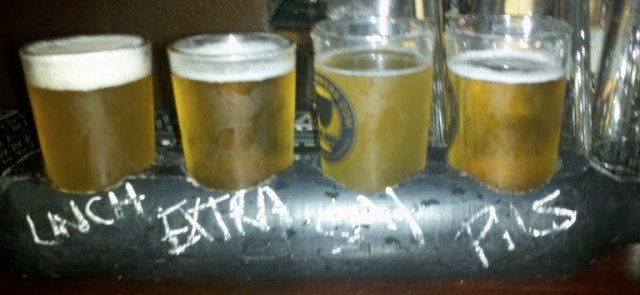
On Tuesday July 10, 2012 Rattle n Hum, a popular NYC craft beer bar held a special event with 12 of its 40 taps pouring Green Flash Brewing Co. beers. Known for their hoppy west coast style beers, I was excited to see a balance between hoppy and European-style beers on the tap list. As I do at many of Rattle n Hum’s  events, I started off the night with a flight of the four Green Flash beers that I had yet to try and wrote down tasting notes as I drank them.

East Village Pilsner (Bohemian Pilsner, 5.3%* ABV) – Having heard good things about Green Flash’s Fizzy Yellow Beer, I was excited to see what this beer had to offer. It poured pale straw in color with a moderate amount of carbonation and a white head that left spots of lacing down my glass. True to style its aroma consisted of lemon peal, grassy hop notes, and some toasty pale malt. While I do not drink pilsners that often, I could tell from the aroma that this one would be spot on for its style. Upon taking my first sip, my palate was met with assertive and crisp grassy and lemony German hop flavor and bitterness that mixed with some semi-sweet bready pale malt at mid palate and made for a smooth finish. * I should note that while Ratebeer has this beer clocking in at 5.8% ABV, a picture on the Green Flash website has it at 5.3% ABV. This dilemma was of concern while drinking East Village Pilsner because the ABV was perceivable in the finish. However, with its crisp and robust hop character, there was enough of a balance for me to be left hoping to find it on tap again some time. Rating 8/10

Saison San Diego (Saison / Farmhouse Ale 4.2% ABV) – Formerly called Summer Saison, this beer poured straw in color with some haziness (it’s unfiltered). Going from most to least prominent, its aroma included bubblegum, wheat malt tartness, clove, and grassy hop notes. These characteristics followed into the taste as the beer danced on my palate due to its carbonation level and “lower end of medium” body.  As I took my final sips, the lemon flavor came out a bit more and the sweet / somewhat tart malt and bubble flavors lingered in the finish. Overall, I feel that this beer is spot on for its style. However, I was left hoping for some additional farmhouse yeast character (spiciness and earthiness). Rating 7/10

Retro Extra Pale Ale (American Pale Ale, 4.9% ABV) – Moving onto the hoppier beers in this flight this pale ale was pale orange in color and had an off white head. Upon taking a whiff I was surprised to pick up floral and grassy hop notes instead of the characteristic west coast citrusy hop flavors known to come out of San Diego breweries. I also picked up some toasty caramel notes from the malts used in this beer. Next, the taste reminded me more of an English pale ale in that the hops were more of a background flavor component and the bitterness was quite low. Though I could attribute the flavor profile of this beer to a freshness issue, the sample I had that night left me wanting something more e.g. a more assertive and or unique hop character. Rating 5/10

Green Flash / Founders Linchpin White IPA (American IPA, 7% ABV) – As the final beer of this flight, I hoped to have saved the best for last. This collaboration beer poured gold in color with a slight cloudiness, which was expected due to the use of wheat malt in this beer. In addition, its white head left a considerable around of lacing on my glass. Though a bit subtle, its aroma included notes of lemon peal, grapefruity and floral hops, and a caramel malt backbone. Having been released fairly recently I was surprised that the flavor profile of this beer was quite malt forward (freshness issue), which masked a lot of the IPA and witbier character I was looking forward to tasting. Luckily, it did finish with some lemon notes and moderate bitterness. When looking pasted the masked flavors, I found the ABV to be masked quite well and that the beer’s body was medium. Rating 6/10

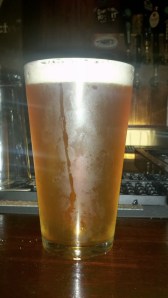
For my final Green Flash beer of the night I chose to order a pint of a beer that I get every time I see it on tap. Named for a San Diego street that has a lot of craft beer bars, 30th Street Pale Ale (6% ABV) poured gold in color with an attractive 1 finger white head. In true San Diego style, its aroma boasted a juicy grapefruit and orange hop character that was balanced by just the right the amount of bready maltiness. These flavor characteristics translated directly into the taste with the grapefruit notes being brighter upfront and then blending with the juicy orange hop notes at mid palate. These flavors left the malt to round out the bitterness and help me appreciate the utter juiciness of the hops. As such, what I like most about this beer is that unlike many hop forward San Diego beers, its juicy hop flavor lasts into the finish instead of leaving the palate with a lingering dry bitterness.  Rating 9/10

Posted in Beer Reviews | Tagged , , , , , , , , , , , | Leave a comment